A Winter Garden Seen in Silhouette
A winter garden silhouette reveals how stems, branches and structures shape a view, helping you notice strong outlines and plan thoughtful seasonal changes.
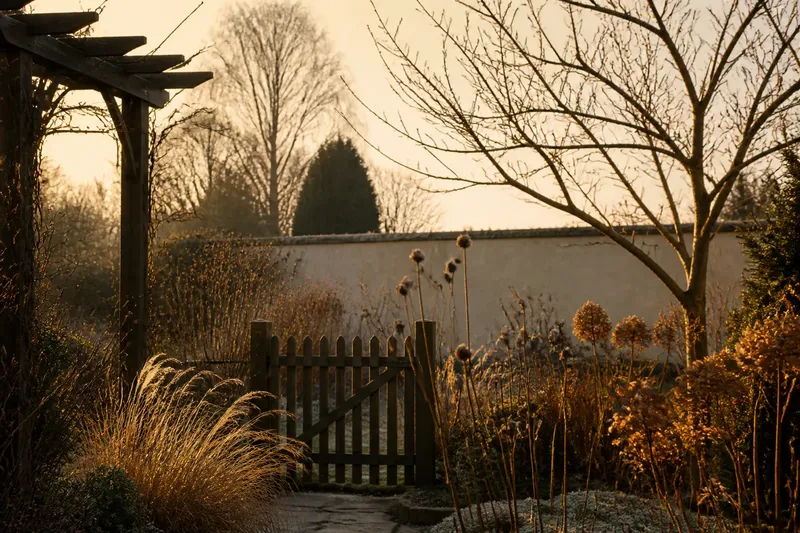
What holds your garden’s attention when flowers and leaves are gone? A winter garden silhouette makes the answer easier to see: look for the outlines of stems, branches and structures against the sky, a wall or a pale surface. This simple seasonal exercise can show where the garden already has shape, where its forms compete, and what may be worth adjusting later.
Choose a view you pass often, such as a kitchen window or the gate. Look on a clear day, or when a light sky sits behind darker plants. You do not need to identify every species. Start by noticing the edges: upright, arching, spreading, branching, fine or dense. The outline is the subject, not the plant’s name.
Begin with the outline rather than the plant
In leafy months, colour and mass can conceal the underlying arrangement. Winter strips some of that visual detail away. A clump of ornamental grass may become a fountain of narrow blades; a deciduous shrub may resolve into a few main branches and their smaller divisions. A pergola, fence or bare trellis can become just as prominent as a plant.
Silhouette does not mean a perfectly black shape against a bright sky. It is any readable edge between a form and its background. A twig may stand out against a rendered wall, while a dark branch against evergreen foliage disappears. The same plant can look striking from one position and indistinct from another.
Stand still for a moment, then shift a pace to one side. Notice whether branches separate or overlap, and whether a structure frames the plant or cuts across it. That small change in viewpoint helps distinguish a strong outline from a tangle that only appears clear from one angle.
Choose a view that reveals the garden’s structure
Use a repeatable vantage point so you can compare what you see as the season changes. A doorway, a garden bench or a path junction makes a useful marker. If you prefer to work outdoors, stand where you can see both the foreground and the boundary without craning over a hedge or fence.
Look at three layers in the view:
- Near: seed heads, grasses, low shrubs, pots and edging close to where you stand.
- Middle: the main stems, branches, arches or other forms that carry the view.
- Far: a hedge, wall, fence, neighbouring trees or sky that provides the background.
Ask whether each layer has a distinct edge. Fine stems can read clearly against a plain wall but vanish against a dense hedge. A bare tree may be easy to read against open sky, yet become confused where its branches cross a roofline or several other crowns.
Say you look from a back door and see a pale fence behind a patch of dried grasses. If you notice that the grass outlines merge with the fence posts, you might later move a container slightly to give the stems a darker backdrop. The expected result is a clearer separation in that view, not a change to the plants themselves.
Read branches, stems and garden structures together
Start with the largest forms. Trace the main line of a tree trunk into its limbs, or follow a shrub from its base towards its outer tips. Is the shape upright, rounded, vase-like, fan-shaped or irregular? These plain descriptions are enough to record what you see. You can add finer detail once the overall shape is clear.
Then compare the plant’s outline with nearby built forms. A narrow trellis may echo a row of straight stems; a rounded arch may contrast with a spreading tree. Neither relationship is automatically better. The useful question is whether the forms feel distinct, quietly related or visually crowded from the chosen viewpoint.
Pay attention to gaps as well as edges. Spaces between branches can form small windows through which a wall, shed or patch of sky appears. If every gap is filled by another stem, the outline may read as a dense block. If the openings are too large for the surrounding scale, a plant may look sparse from that particular angle.
Keep natural variation in view. Not every branch needs to make a clean graphic shape, and a loose, irregular crown may suit an informal garden better than a clipped outline. The aim is to describe the forms accurately before deciding whether anything needs changing.
Record what the silhouette is telling you
A quick note is often more useful than a photograph alone. Write down the viewing position, the background and one or two observations about the outline. If you take a picture, use the same position next time, and avoid treating a single image as a full account: a photograph flattens distance and can make overlapping branches look more tangled than they appear in person.
- Mark the view on a rough sketch of the garden.
- Draw the main shapes as simple blocks, lines or arcs.
- Circle points where branches overlap or disappear into the background.
- Note which forms remain legible from more than one position.
- Record any seasonal features, such as persistent seed heads or evergreen foliage, that change the outline.
Separate observation from intention. “The lower branches cross the gatepost” describes what is visible; “remove a branch” proposes an action. Keeping the two apart gives you time to consider whether the overlap is a problem, a useful frame or simply part of the garden’s character.
What should you notice in a winter garden silhouette?
Which plants keep their outline through winter?
Deciduous trees and shrubs reveal their branch patterns once their leaves have fallen, while evergreen plants retain their broader masses. Grasses, seed heads and some perennial stems may keep a visible shape for part of the season. Notice what remains in your own garden rather than assuming every plant holds its form for the same length of time.
How can I see a branch shape more clearly?
Try another position where the branch sits against a quieter background, such as open sky or a plain wall. If the view stays crowded, note the overlap and return later before deciding whether pruning or repositioning a nearby object is appropriate.
Should I cut back every untidy stem?
No: some stems and seed heads add winter structure, and some may provide useful cover for wildlife. Treat the silhouette as a reason to observe, not an automatic instruction to prune; follow plant-specific guidance and local wildlife protections where they apply.
Can a wall or fence improve the view?
A plain surface can make fine branches and stems easier to distinguish, while a busy fence or hedge may swallow them. Check the view from the places you actually use before changing a background, because the same surface may frame one plant and obscure another.
Turn a winter observation into a measured design choice
Once you have recorded the outlines, choose one question to carry into the next season. You might want a branch pattern to remain visible from a doorway, a patch of grass to stand apart from its background, or a trellis to feel less dominant beside a shrub. A single clear intention is easier to assess than a broad wish to make the garden look tidier.
Before acting, check whether the issue is tied to the view rather than the plant. A small change in where a pot stands, or where you pause on a path, may clarify a silhouette without altering a mature tree. If pruning is under consideration, the suitable method depends on the plant and the purpose; consult a qualified arborist for significant tree work, and follow the plant’s care guidance.
Return to the same viewpoint as spring approaches. New shoots will soften some edges, and leaf growth may cover gaps that were easy to see in winter. The notes from your winter garden silhouette can help you decide which outlines deserve to remain visible, and which are simply useful to notice for a few quiet months.
Keep the sketch somewhere you can find it next winter; a familiar view makes changes in shape easier to recognise, even when the garden’s details have shifted.